



RVers know that holding tank sensors NEVER read correctly — and because you can't see what's happening inside your tanks, you may be wondering if you're rinsing your tanks completely.
You might even believe that misreading sensors are just an inevitable part of RV life, BUT, I’m here to tell you: It doesn’t have to be that way.
Today, I’ll be covering why sensors misread, how to clean your holding tank sensors, reliable sensor alternatives, and the ONE holding tank rinsing method that consistently delivers the cleanest tanks.
The reality is, smarter tank maintenance goes a long way. With a few simple changes, you can spend less time dealing with your tanks and more time making memories at the campground.
How Do RV Holding Tank Sensors Work?
At the most basic level, RV holding tank sensors function as an electrical circuit where the rising water level in your holding tanks completes the circuit and lights up the corresponding level gauge.
Why Do RV Holding Tank Sensors Misread?
RV holding tank sensors misread for a lot of reasons, which is probably why we’ve all experienced unreliable readings at one point or another. The main reasons include:
- Debris (Most Common & Restorable): Removable debris like human waste, toilet paper, grease, or food particles cover the sensor, hanging off of it into the liquid below.
- Mineral Deposits (Require Sensor Replacement): Non-cleanable mineral, calcium, or hard water deposits cover the sensor and prevent it from functioning properly.
- Wiring Problems (Require Repair or Replacement): Broken wire from a ring terminal, wire insulation rubbing through and causing the wire to ground, or a pinched wire.
- Control Problems (Least Common & Require Replacement): Poor connection at the Molex connector to the circuit board, failed resistors, etc. can also prevent sensors from working.
How to Clean RV Holding Tank Sensors
Cleaning Black Tank Sensors
Steps for cleaning black tank sensors:
- Close black tank valve (Always keep closed unless actively dumping).
- Fill black tank with water.
- Shake bottle of Unique Restore-It, and pour 16 ounces into RV toilet.
- Allow Restore-It to work for 12-72 hours, or more!
- Dump your black tank.
- Rinse your black tank thoroughly (fill completely with freshwater and dump. Repeat 2 times for a clean tank).
- Close black tank valve again.
- Wait 1 hour to allow sensors to dry completely.
- Test black tank sensors.
- Repeat as needed (2-3 times).
If the sensors are still misreading after a second or third cleaning, your sensor wires may be broken and should be replaced.
Cleaning Gray Tank Sensors
Steps for cleaning gray tank sensors:
- Fill gray tank about halfway full with water.
- Pour Dawn Ultra down RV kitchen sink (at least 12-20 ounces, but more is better!).
- Fill gray tank completely full with water.
- Let Dawn Ultra work overnight.
- Dump the tank.
- Wait 1 hour to allow sensors to dry completely.
- Test gray tank sensors.
- Repeat as needed (2–3 times).
If the sensors are still misreading after a second or third cleaning, your sensor wires may be broken and should be replaced.
Want Something More Reliable? Garnet SeeLevel Holding Tank Sensors
Garnet SeeLevel Holding Tank Sensors have been available for aftermarket installation for over 30 years, and are still the most reliable, go-to sensors for RV holding tanks.
They provide more reliable readings because the sensor probes are positioned outside of the tank, meaning that waste and grease cannot stick to the sensors and cause them to misread.
The ONLY Way to Rinse Your Tanks
Rinsing and deep cleaning your RV’s black tank is important because after you dump your tank, waste and debris can often linger in crevices, tank ledges, sensor probes, and low points.
When the remaining waste accumulates, it can lead to foul odors, clogs, and misreading sensors in your RV.
As a best practice, we recommend thoroughly rinsing your tank after every dump.
Tank Rinsing Methods You Should Avoid
Many beginner RVers waste time and money trying to rinse their tanks using improper tools and methods.
Online you can find many secret myths or hacks to rinse your black tank:
- Ice & Driving: Dropping ice into the toilet before driving is problematic because not only does the ice melt too quickly, but it does little to scrub the tank walls (no matter how recklessly you try to drive around).
- Chemical Cleaners: Harsh chemical cleaners can disrupt the natural breakdown of waste and can ruin rubber seals and gaskets.
- The Soap Hack: Heavily scented soaps don’t dissolve properly, simply mask odors, and can leave residue behind.
- Calgon & Dawn:Don't fall for this one. Calgon will not help waste slide out of tanks any easier, and Dawn (though AMAZING for gray tanks!) will do nothing inside of a black tank.
Fill It, Dump It, Repeat: Rinsing Your Black Tank with The Unique Method
So, what is the most safe and effective method for rinsing RV black tanks?
|
The best way to thoroughly rinse your RV’s black tank is to fill it completely with clean water, and then dump the contents. Repeat this 1 to 2 times to effectively rinse your black tank. |
Why is This Rinsing Method So Effective?
This method is extremely simple and outperforms internally mounted tank rinsers, tank wands, or external tank flushes. But why?
Extensive Testing
Through extensive testing of external rinsing devices, we’ve found that they are highly ineffective for the majority of RV wastewater systems. The only way to be sure you’ve drained all the remaining waste out is to routinely fill and dump your tanks.
➡️ So next time you go to dump and rinse your black tank, instead of relying on tools, gadgets, and “secret hacks,” simply use water — it’s literally the BEST thing you can add to your RV’s holding tanks.
Waste Disruption
As you fill your tank and empty it, there is significant sloshing that happens. This momentum disrupts the liquid inside of the tank and allows all of the lingering waste and debris on the ledges, nooks, and crannies to be washed away.
➡️ Thoroughly rinsing your tanks with water ensures there’s no remaining debris in even the most hard-to-reach places.
Recommended Tank-Dumping Habits
The other important distinction with this method is filling your tanks completely.
If you’re following RV holding tank best practices, then you’re typically dumping your tanks whenever they are two-thirds (⅔) full. This is an excellent practice, however, it does mean that any waste or debris that is sloshed toward the top of your holding tanks never gets rinsed out properly.
➡️ By filling your RV holding tanks completely, you’re ensuring that the entire interior of your holding tanks are thoroughly rinsed.
Prevents Misreading Sensors
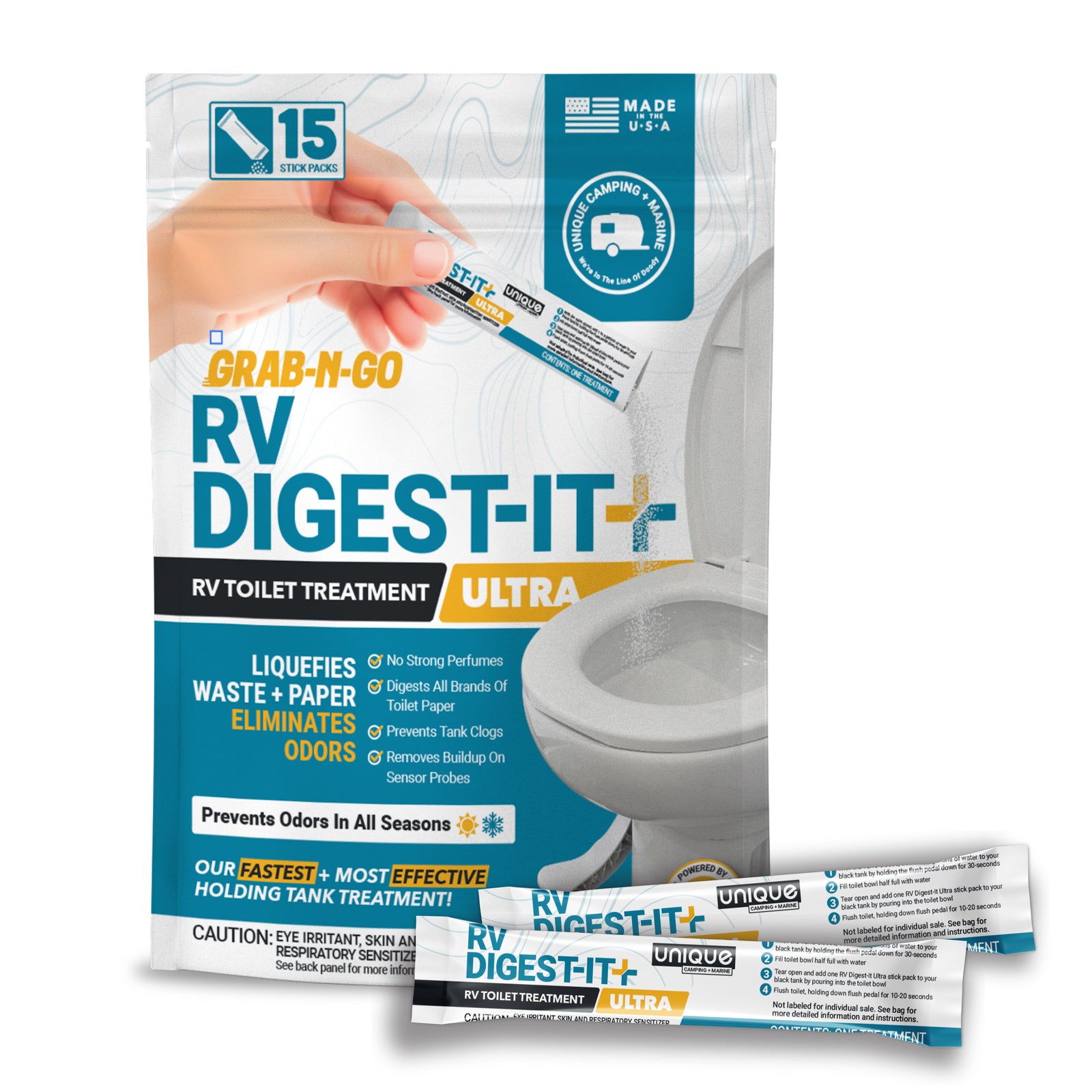
Even if you’re using a high-quality, bacteria- and enzyme-based tank treatment, like Unique Digest-It Ultra, when you drain your tanks, you are essentially taking a mudslide of poop and paper and jamming it against the sensors that are located near the discharge line.
➡️ Just because waste and debris is fully broken down by your tank treatment, you can still experience misreading sensors unless you thoroughly rinse everything out of the tank.
Have Questions About Your RV?
Contact the friendly and professional Customer Support Team at Unique Camping & Marine for answers today.
About This Blog
My name is Annie, and I’ll be coming to you each month with expert tips and information that benefit all types of RVers. Each piece is written, not by Artificial Intelligence, but by an Actual Individual... me!
I research each subject, consult industry professionals, and verify information with certified RV techs before this article ever gets published.
If there’s a topic you’d like me to cover, feel free to email me.
- Annie


